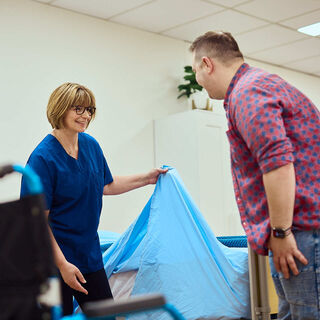
If you want a career where your work can make a meaningful difference in someone’s daily life, individual support may be the right path for you.
Individual support includes helping older people and people with disability live safely, confidently and as independently as possible. Depending on the role, this may involve personal care, daily activities, mobility assistance, community participation and emotional support.
A common training pathway is the nationally recognised CHC33021 Certificate III in Individual Support (Ageing and Disability). This qualification develops practical, person-cententred skills for work across aged care and disability support settings.
What is individual support?
Individual support is assistance designed around a person’s needs, preferences, abilities and goals.
It is not simply about completing tasks for someone. Quality support respects each person’s dignity, privacy, culture, rights and choices. It focuses on helping people maintain their independence and participate in their home and community.
Depending on the workplace, an individual support worker may:
- Assist with personal care and daily routines
- Support mobility and safe movement
- Encourage independence and community participation
- Follow individual care or support plans
- Communicate with clients, families and other workers
- Record and report relevant information
- Recognise and respond to changes in a person’s needs
- Follow safe work and infection-control procedures
The responsibilities of each position will vary according to the employer, workplace and people being supported.
What jobs can the Certificate III lead to?
The Certificate III in Individual Support (Ageing and Disability) may support applications for entry-level roles such as:
- Aged care support worker
- Personal care worker
- Personal care assistant
- Disability support worker
- Home care support worker
- Community support worker
Job titles and responsibilities differ between organisations. Some employers may also require particular screening checks, a driver’s licence, access to a vehicle, first aid certification or previous experience.
Completing a qualification does not guarantee employment, but it can help you develop the skills and evidence of training employers commonly look for.
Why study both Ageing and Disability?
Choosing a qualification with both the Ageing and Disability specialisations can give you a broader introduction to the support sector.
The Ageing specialisation focuses on supporting older people, including those receiving care at home, in the community or in residential aged care.
The Disability specialisation focuses on supporting people with disability to exercise choice, participate in their communities and work towards their personal goals.
Studying both areas may give you greater flexibility when exploring potential workplaces. However, individual employers will still set their own recruitment and role requirements.
What will you learn?
The Certificate III in Individual Support focuses on practical skills for providing person-centred support under supervision or delegated responsibility.
Training may include:
- Understanding individual needs, preferences and goals
- Supporting independence and wellbeing
- Communicating respectfully with clients and families
- Following individual care and support plans
- Understanding legal and ethical responsibilities
- Maintaining professional boundaries
- Using safe work and infection-control practices
- Recognising and reporting changes or concerns
- Supporting social and community participation
- Protecting privacy, dignity and personal choice
At Auctus Training Institute, students participate in trainer-led classes, practical activities and simulated workplace learning before applying their skills during placement.
Is work placement required?
Yes. Students completing CHC33021 must undertake at least 120 hours of work placement in an approved service environment.
Placement gives you an opportunity to apply your learning under appropriate workplace supervision. It can also help you understand the responsibilities, routines and expectations of support work.
Auctus provides placement support and works with service providers to help students complete this requirement. However, placement is a shared process. Students must remain engaged, provide the required documents, meet the host organisation’s requirements and be reasonably available for suitable placement opportunities.
A particular placement provider, location, roster or starting date cannot be guaranteed.
If you already work in a relevant support role, your employment may be considered for placement purposes. The workplace, duties, supervision and assessment arrangements must be reviewed and approved by Auctus before any hours can be counted.
What screening checks might you need?
Screening and workplace requirements depend on the employer, placement provider, position and people being supported.
Depending on your circumstances, you may need:
- A National Police Check
- An NDIS Worker Screening Check
- A Working with Children Check
- An aged care-related screening check
- First aid or manual handling training
- Relevant NDIS worker orientation modules
- A current driver’s licence
- Access to a suitable vehicle for community-based work
Not every check applies to every role. Before paying for a screening check, confirm what is required for your course, placement or prospective workplace.
Auctus will explain the requirements associated with training and placement during the enrolment process.
Is individual support a growing field?
Australia has a significant and continuing need for aged care and disability support services.
Jobs and Skills Australia reports that the broad Aged and Disabled Carers occupation employs approximately 376,300 people nationally, with annual employment growth of around 27,100 workers.
These figures show the size of the overall occupation, but they do not guarantee employment for an individual graduate. Job opportunities can vary according to location, employer demand, previous experience, screening requirements and working availability.
Is individual support right for you?
Individual support can be rewarding, but it also carries significant responsibility.
You may be suited to this field if you are comfortable:
- Working closely with people from different backgrounds
- Listening to and respecting individual choices
- Providing personal care professionally
- Following workplace policies and support plans
- Communicating clearly with clients and colleagues
- Completing written or digital records
- Responding calmly when situations change
- Receiving feedback and working under supervision
- Managing the physical and emotional demands of support work
Reliability, empathy, patience and professional boundaries are important. Before enrolling, consider whether the working environments and responsibilities match your abilities, interests and career goals.
How long does the course take at Auctus?
Auctus currently offers face-to-face training at its Payneham campus through daytime and evening study options.
The advertised schedules are approximately:
- Daytime training: 10 weeks of scheduled classes
- Evening training: 15 weeks of scheduled classes
Students must also complete the required 120 hours of work placement.
Your total completion time may depend on the intake timetable, placement arrangements, attendance, assessment progress and individual circumstances. Course schedules and intake dates may change, so always confirm the current information before enrolling.